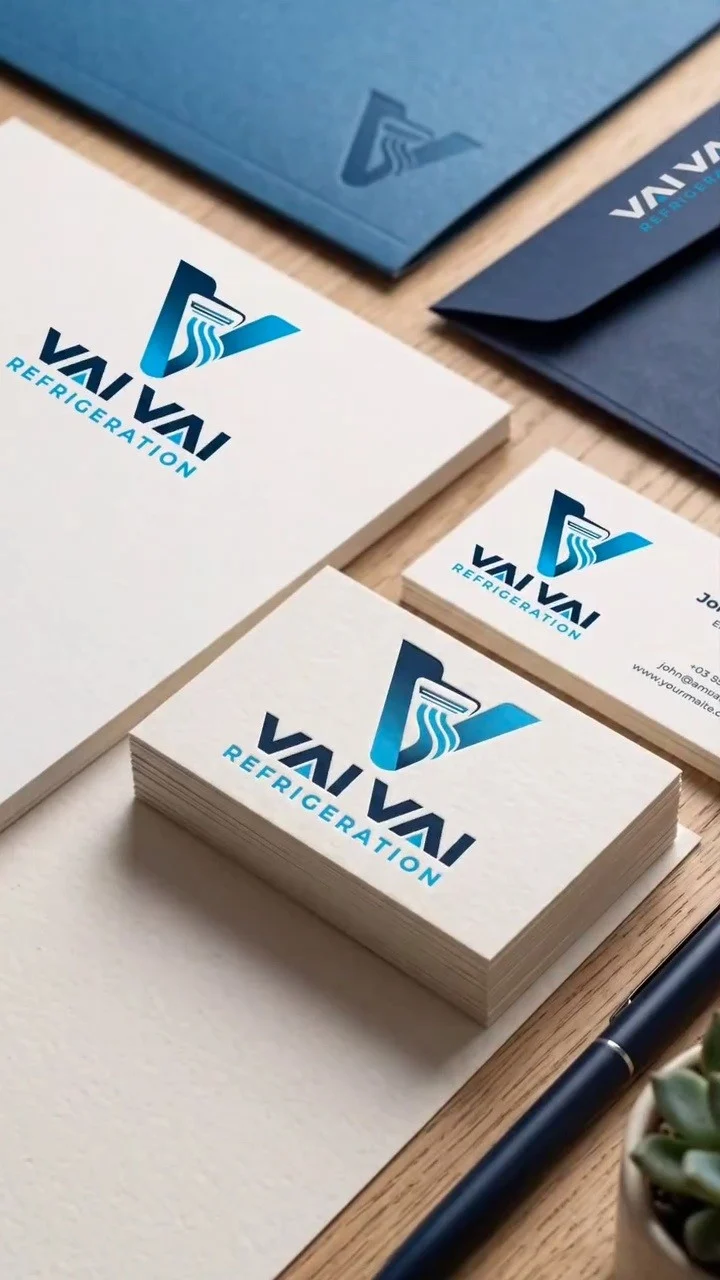
Business cards have outlived plenty of predictions about their death. In meetings, at trade fairs and on shop counters, a well-made card is still the quickest way to leave something behind. The catch is that people decide in seconds whether to keep it.
These tips apply whether you’re designing your own card or briefing a designer. None of them are trends; they’re the basics that keep working.
1. Know your size before you start
Card sizes differ by country, and designing for the wrong one means awkward cropping later:
- US and Canada: 3.5 × 2 inches (88.9 × 50.8 mm)
- UK and most of Europe: 85 × 55 mm
- Some other countries: 90 × 50 mm or 90 × 55 mm are common
If you’ll hand out cards in several countries, pick the size your main market uses and keep the layout simple enough to adapt.
2. Lead with one thing
Decide what someone should remember: your name, your business, or what you do. Make that the biggest, clearest element and let everything else step back. A card that tries to say everything at the same size says nothing.
3. Only include details people actually use
Name, role, phone or WhatsApp, email and website cover most needs. Add an address only if customers visit you. Every extra line makes the card harder to read, so cut social media links unless that’s where your customers really find you.
4. Give the type room to breathe
Small text is the most common problem on business cards. As a rule of thumb, keep contact details at 7 to 8 points or larger, depending on the typeface, and make sure there’s strong contrast between text and background. Pale grey text on a white card might look elegant on screen, but it’s hard to read in a dim restaurant.
5. Use both sides
Double-sided printing usually costs only a little more. A common pattern that works: logo or brand pattern on one side, contact details on the other. The logo side makes the card memorable; the details side makes it useful.
6. Respect bleed and the safe zone
Printers cut cards from large sheets, and the blade can shift slightly. Two settings protect your design:
- Bleed: extend background colours and images about 3 mm (or 0.125 inch) beyond the edge, so no white slivers appear after cutting.
- Safe zone: keep text and logos at least 3 to 4 mm inside the edge, so nothing important gets trimmed.
7. Design in print colours
Screens show colour as light (RGB); printers use ink (CMYK). Bright screen colours, especially vivid blues, greens and oranges, often print duller. Set up the file in CMYK from the start, use your brand’s CMYK or Pantone values, and expect small differences between screen and paper.
8. Choose paper and finish deliberately
The feel of a card says as much as the design. A few choices make the biggest difference:
- Thickness: heavier card stock (around 350 gsm and up) feels more substantial than thin paper.
- Matte or gloss: matte feels calm and is easy to write on; gloss makes colours pop but shows fingerprints.
- Special finishes: foil, spot UV, embossing or rounded corners can lift a simple design. Use one, not all of them.
Ask your printer for samples before you commit.
9. Add a QR code only when it has a job
A QR code is useful if it leads somewhere specific, such as your WhatsApp chat, a booking page or your portfolio. Linking to a general home page rarely adds much. Keep the code at least about 2 cm square, leave white space around it, and test it on several phones before printing.
10. Match the rest of your brand
Your card should look like it belongs with your sign, your packaging and your social media. Use your brand colours, typefaces and logo version consistently. If you don’t have a brand identity yet, it’s worth starting there, because a card designed in isolation often needs redoing once the rest of the brand is in place.
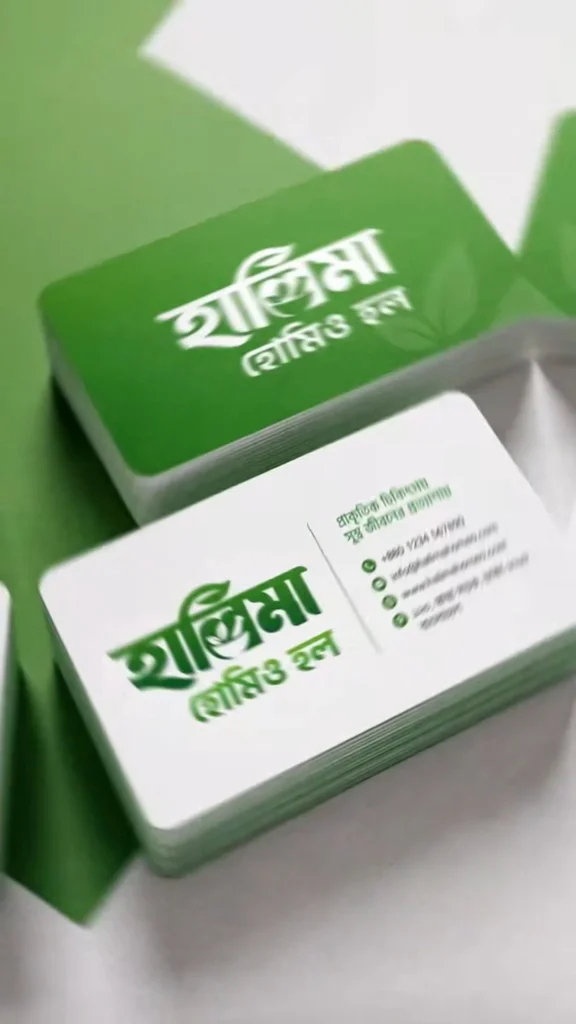
You can see how one identity carries across cards and stationery in projects like Halima Homeo Hall and Bilal Aquarium.
11. Always check a proof
Before printing hundreds of cards, check a digital proof carefully and, for larger runs, ask for a printed sample. Read every number and email address out loud. A wrong digit on five hundred cards is an expensive typo.
Common mistakes to avoid
- Borders close to the edge. A thin border looks neat on screen, but small shifts in cutting make it visibly uneven on paper. Either keep borders well inside the safe zone or leave them out.
- Too many typefaces. One typeface, or two at most, keeps a small card calm and readable.
- Low-resolution logos. A logo copied from a website will print blurry. Always use the vector file (AI, EPS, SVG or PDF).
- Dark text on dark photos. Photos behind text reduce contrast. If you use one, keep the text area plain.
- Printing at home for a big meeting. Office printers can’t match professional card stock or cutting. If first impressions matter, use a print service.
What about digital cards?
Digital business cards, QR profiles and NFC cards are useful additions, especially at events. They don’t replace paper for most businesses, because many people still expect something to hold, keep in a wallet or pin to a board. The simplest approach is to do both: a printed card with a QR code that opens your digital profile or WhatsApp chat.
A quick checklist before you print
- Correct size for your country
- One clear focal point
- Only the contact details people use, all double-checked
- Text at a readable size with strong contrast
- 3 mm bleed and a safe margin of at least 3 mm
- CMYK colours using your brand values
- Paper and finish chosen from real samples
- QR code tested, if you use one
Need cards that get kept?
I design business cards and stationery that match your brand, read clearly and arrive at the printer set up correctly, with bleed, crop marks and the right colour profile. If you need a logo first, a brand identity package includes your business card. Send me your details and I’ll reply within 12 hours.